If you've ever managed Meta Ads, you've probably heard the same sentence over and over again:
"The creatives have stopped working."
A few days later, the design team creates new banners. The video editor produces another reel. The copywriter rewrites the headline. Performance improves slightly—or sometimes not at all.
The cycle repeats.
Most businesses assume that every performance drop is a creative problem. It feels logical because creative is the most visible part of an advertisement. But visibility doesn't always equal importance.
In reality, creative is only one variable in a much larger growth system.
Behind every successful Meta campaign is an invisible infrastructure: tracking accuracy, attribution, audience quality, website experience, and measurement reliability. When one of these systems breaks, Meta receives poor signals, optimization becomes unreliable, and scaling becomes increasingly expensive.
If you're constantly replacing creatives but your campaigns never scale consistently, you're probably solving the wrong problem.
The Myth: "Our Creative Isn't Good Enough"
Creative absolutely matters.
It grabs attention, earns the click, and influences the first impression. Without a strong creative, even the best targeting won't generate results.
But here's the mistake most marketers make:
They treat creative as the only growth lever.
Imagine driving a Formula One car with a broken GPS, leaking fuel, worn-out tires, and faulty brakes.
Would installing a better steering wheel make you faster?
Of course not.
Meta Ads work exactly the same way.
Your creative is the steering wheel.
Everything else determines whether the car can actually finish the race.
Many advertisers replace creatives every week while ignoring:
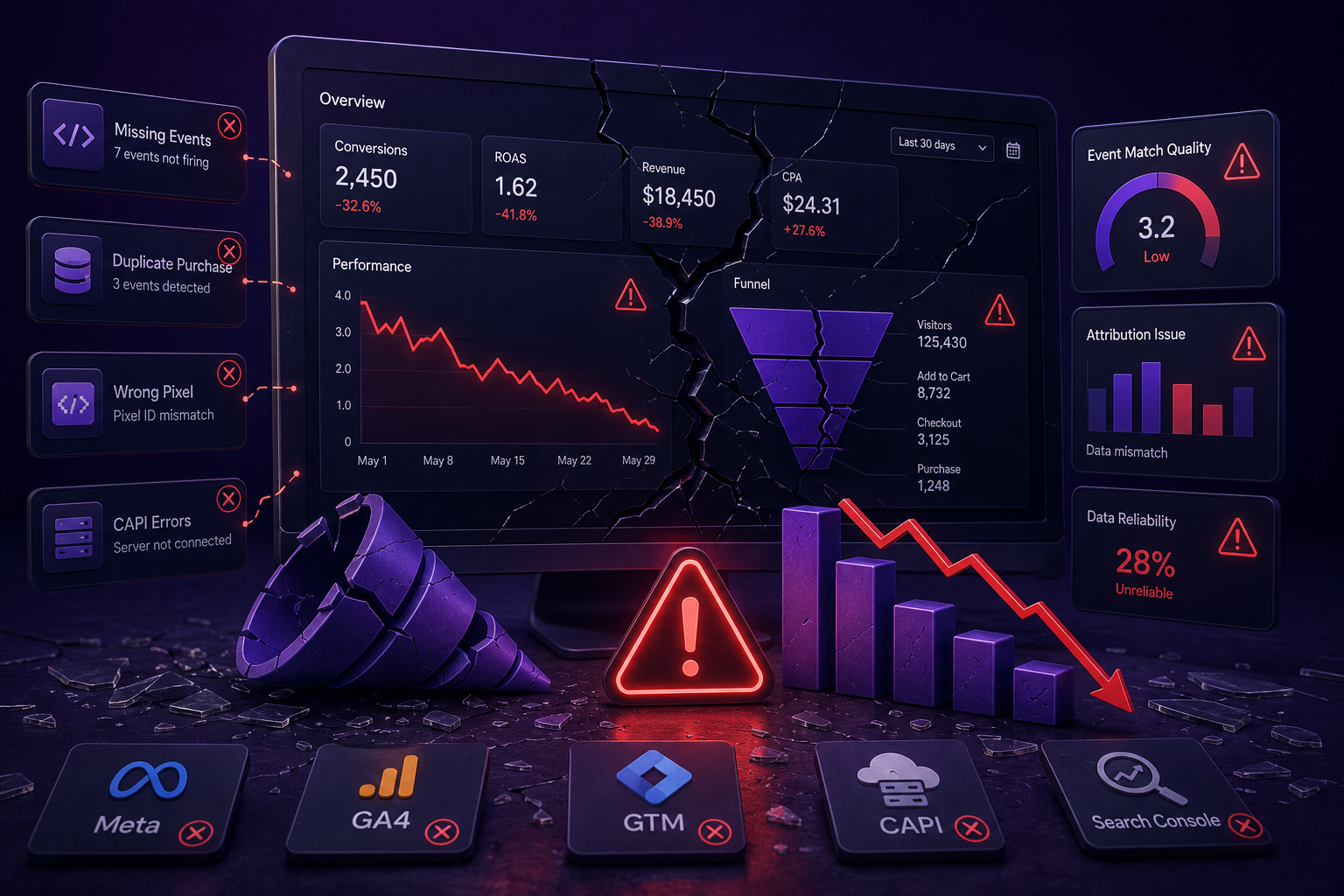
Broken Meta Pixel implementation Missing Conversion API events Duplicate purchase events Poor audience signals Slow landing pages Incorrect attribution Weak conversion funnels
The result?
More creative production.
The same disappointing performance.
Tracking Problems: The Hidden Growth Killer
Meta's machine learning is only as good as the data it receives.
Think of Meta as a student taking an exam.
If you provide accurate answers, the student becomes smarter over time.
If you provide incomplete or incorrect answers, the student keeps making poor decisions.
Tracking is that answer sheet.
Meta Pixel Alone Isn't Enough
Many businesses install Meta Pixel and assume tracking is complete.
Unfortunately, browser-based tracking has become increasingly unreliable because of:
Browser privacy restrictions iOS privacy updates Ad blockers Cookie limitations
This means Meta often loses valuable conversion data.
When conversions disappear, optimization quality declines.
Why Conversion API Matters
Conversion API (CAPI) sends server-side events directly to Meta.
Unlike browser-only tracking, CAPI helps recover lost conversion signals, improves attribution, and provides more consistent optimization data.
Pixel and CAPI are not competitors.
They work best together.
A healthy setup combines both browser events and server-side events to create a stronger measurement system.
Duplicate Events Create Confusion
Another common issue is duplicate event firing.
For example:
Browser Purchase event fires once. Server Purchase event fires again. Plugin sends another Purchase event.
Meta now receives multiple purchase signals for a single customer.
The algorithm becomes confused.
Reported ROAS becomes inflated.
Optimization becomes less reliable.
Missing Events Are Just as Dangerous
Sometimes the opposite happens.
Important events never reach Meta.
Examples include:
Add to Cart not firing Initiate Checkout missing Purchase event blocked Lead event never triggered
When Meta can't see the customer journey, it can't learn from it.
You're asking the algorithm to optimize using incomplete information.
Low Event Match Quality
Event Match Quality (EMQ) measures how well Meta can match your events to real users.
Poor matching usually happens when websites fail to send identifiers such as:
Email Phone number External ID IP Address User Agent
Higher match quality generally provides better optimization opportunities because Meta has stronger confidence in identifying converters.
The takeaway is simple:
Without reliable tracking, Meta isn't making bad decisions—it simply doesn't have enough accurate information to make good ones.
Audience Problems: Better Signals Create Better Results
Many advertisers obsess over targeting options.
Ironically, Meta has become less dependent on manual targeting than ever before.
Today's algorithm performs best when it receives high-quality conversion signals.
That changes how we think about audiences.
Broad Audiences Often Win
Years ago, marketers stacked dozens of interests together.
Today, excessively narrow audiences often restrict Meta's ability to learn.
Broad targeting gives the algorithm more room to find likely buyers—provided your tracking and optimization are working correctly.
Retargeting Isn't Unlimited
Retargeting is powerful.
But it has a natural ceiling.
If only 2,000 people visit your website each month, your retargeting audience can never become large enough to support aggressive scaling.
Many businesses try to scale using the same small audience until frequency climbs, costs increase, and performance declines.
Lookalike Audiences Depend on Seed Quality
A Lookalike Audience is only as good as its source data.
If your seed audience includes:
Low-quality leads Refund customers Fake purchases Duplicate events
Then your Lookalike Audience inherits those problems.
Garbage in.
Garbage out.
First-Party Data Is Becoming a Competitive Advantage
As third-party tracking becomes less reliable, businesses that collect their own customer data gain a significant advantage.
Examples include:
Email subscribers Purchase history CRM data Loyalty programs Customer lifetime value Offline conversions
The more high-quality first-party data you feed back into Meta, the smarter the optimization becomes.
Your Landing Page May Be Losing the Sale
Even perfect campaigns can't fix a poor website experience.
Ads generate attention.
Websites generate revenue.
If visitors arrive but fail to convert, Meta eventually learns that your traffic isn't producing enough successful outcomes.
That increases acquisition costs over time.
Slow Speed
Every additional second of loading time creates friction.
Users leave before seeing your offer.
Bounce rates increase.
Conversion rates decline.
Poor User Experience
Visitors should immediately understand:
What you're selling Why it matters What they should do next
If navigation is confusing or important information is hidden, users lose confidence quickly.
Weak Call-to-Action
Many websites bury the primary action beneath unnecessary content.
A strong CTA is:
Clear Visible Relevant Easy to complete
Every extra step reduces conversions.
No Trust Signals
People rarely purchase from websites they don't trust.
Trust is built through visible proof.
Examples include:
Customer reviews Testimonials Secure payment badges Return policies Delivery information Real product images Company information
Trust reduces hesitation.
Reduced hesitation improves conversion rates.
A Practical Framework for Scaling Meta Ads
Instead of constantly changing creatives, use a structured optimization framework.
1. Diagnose
Before making changes, identify the actual bottleneck.
Ask questions such as:
Is tracking accurate? Are conversions being recorded correctly? Are audiences saturated? Is the landing page converting? Are attribution settings consistent?
Never optimize based on assumptions.
Optimize based on evidence.
2. Measure
Collect reliable performance data.
Monitor metrics beyond ROAS alone, including:
CTR CPC CPM CPA Conversion Rate Landing Page Views Purchase Value Event Match Quality Funnel Drop-off Attribution Comparison
Good measurement turns opinions into facts.
3. Optimize
Now improve the weakest part of the system.
Sometimes the answer is:
Better creative
Sometimes it's:
Faster pages Cleaner tracking Better offers Improved audience quality Stronger checkout flow Better event implementation
Optimization should always focus on the biggest bottleneck first.
4. Scale
Only increase budget after the system proves it can consistently generate profitable results.
Scaling without reliable measurement is simply increasing the size of your mistakes.
True scaling is about improving efficiency before increasing spend.
A campaign that consistently produces reliable signals can often outperform campaigns with far larger budgets.
Conclusion
The biggest misconception in performance marketing is believing that every advertising problem is a creative problem.
In reality, Meta's algorithm doesn't optimize beautiful designs.
It optimizes signals.
If your tracking is broken...
If your attribution is inaccurate...
If your audience data is weak...
If your landing page leaks conversions...
Then no amount of creative testing will consistently solve the problem.
The businesses that scale successfully don't just create better ads.
They build better measurement systems.
Because in modern performance marketing, sustainable growth doesn't begin with another creative.
It begins with trustworthy data.
And that's why most businesses don't actually have an advertising problem.
They have a measurement problem.